COOL COIN SHOWCASE, #2

Updated: Dec 27, 2025
December 25, 2025
1874 PROOF INDIAN CENT
Hi Folks,
Happy Holidays! Next week before FUN we will have a Newsletter that describes what inventory we will bring to FUN. We will be at Table #334 from Wednesday through Saturday. Please come by to peruse cool coins and to say hi!
In our Second CCS, we have a gorgeous Proof Indian Cent to offer. As we all know, Indian Cents were minted from 1859 to 1909. A change from copper-nickel alloy to bronze alloy occurred in 1864. Bronze was the alloy used until the series ended in 1909. Proof Indian Cents were minted in all years of the series. In the early years, until 1877, Proofs were estimated to have been minted from a few hundred up to as much as 1150 per year. In 1874, the year of the example we offer here, the estimated proof mintage is 700 which was slightly lower than previous years. After 1877, the mintages of Proof Indian Cents increased to a few 1000s each year, the lowest is for the year 1907 at 1475, the highest is for the year 1883 at 6609. Not surprisingly, the later dates are more available in the marketplace and those from 1877 and earlier do not come available as often. This is borne out in the CAC populations where most of these early dates number in the 30 to 50 range. The later dates have CAC populations of up to a couple 100, although some later dates, such as the 1897 and 1898 have CAC numbers that are comparable to the early dates.
One of the biggest challenges in collecting Proof Indian Cents is their eye appeal for a given grade. Copper coins can have negative eye appeal from carbon spots and flecks. Also, for proofs in particular, depending on how they were stored for the past decades, the tone they develop can be very different from coin to coin. They can at present end up with splotchy toning and/or a color palette that does not attract the eye. Alternatively, they can also have an attractive color palette and a more regular progression of toning over the surfaces that can have strong positive eye appeal. Suffice to say then, when selecting a Proof Indian Cent these issues should be considered and they also tie into the value placed on any given example.
With these issues in mind, we present this 1874 Proof Indian Cent in CACG PR65RB. Below are three separate sets of images. In the first set the 2 lights were against the lens in the traditional set up. In the second set, the slab is slightly tilted toward the lights to bring out salient features of the surfaces and to provide a subtle difference in the perspective of the coin relative to the traditional set up in the first image. In the third set, we used axial lighting that brings out the color of the proof mirrors and over the devices. The latter set of images is nearly identical to that for which CAC has on its website for this example.

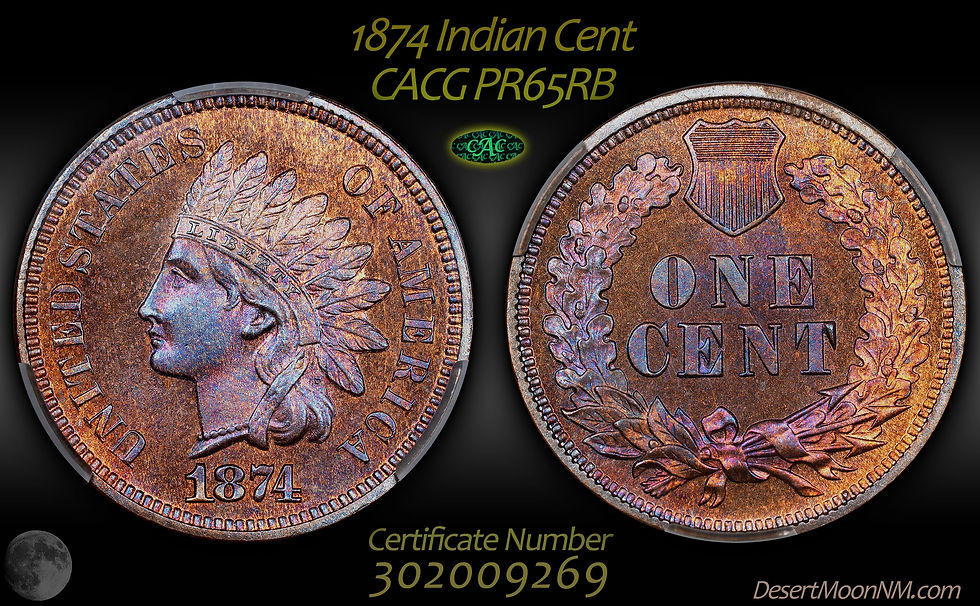

Collectively, these images show an RB Proof that meets the criteria of having superb eye appeal – a rich color palette of rose, deep azure and violet on the mirrored surfaces and devices, smooth progressions of color across the surfaces, and no detracting carbon flecks or spots. There is a lot more red on the surfaces than the images show, particularly near the rims, justifying the RB designation. This is exactly what we hope to see when selecting a Proof Indian Cent. For the 1874, CAC/CACG has stickered/graded 56, including 39 designated RB (2 are RBCAM), and only 4 in RD/RDCAM. In PR65RB, the population is 19 with only 5 in PR66RB, none higher. The prices in the guides double from PR65RB to PR66RB, so the example we offer here lies in a value sweetspot.
In 1874, one set of dies were used to make the Proof Indian Cents. The obverse proof die is identified by specific markers. The two most used are the die lines coming out of the denticles into the field to the left of the first S in STATES, and an extended line off the diagonal to the southwest of the 4 in the date. The latter was the result of a defective digit punch according to Rick Snow in his book ‘The Flying Eagle & Indian Cent Attribution Guide’. Here is a link to order Rick’s Guide books in Flying Eagle and Indian Cents:
So here is a relatively uncommon Proof Indian Cent with drop-dead gorgeous color and eye appeal for your Holiday enjoyment.
Here is the link to the listing on our Coins for Sale page:
Thanks for reading and as always you can email us at desertmoonnm@yahoo.com to inquire about this or any other coin on our website.


Comments